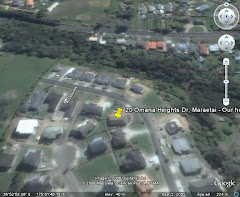
There are sheep everywhere. While we were staying in Mount Albert, in the middle of the city, we would pass green paddocks of little white sheep wedged between the houses (the paddocks, not the sheep). Driving from one part of Auckland to another, one passes - you guessed it - fields of sheep. This is the only country I have been to where a regional nature reserve consists of a narrow band of indigenous coastal forest bordered by, yup, vast rolling expanses of pastures filled with sheep (really - Omana Regional Reserve, Maraetai). The lamb-and-mint hamburgers are delicious. The many Indian immigrants are in their element concocting lamb curries. There is a burgeoning trade in sheep soft toys. Mutton is the same price as chicken in the supermarkets.
Sheep tend to feature in a number of our favourite activities, such as walking through the lovely Omana Reserve, which is within easy walking distance from us, and sightseeing in the area. Two weekends ago, we decided to sally forth and take in one of the many weekend
 activities that we so enjoy about living in Auckland. This time we decided to go to the Clevedon School Agricultural Day. Clevedon is a very pretty farming village close to Maraetai, slightly inland, and is famous for its vineyards, among other things. Clevedon School has a policy that all its students must at some point raise from birth a farm animal of some sort. So we went to see the children show their pet chickens, pigs, goats, calves and lambs (and pop into a wine-tasting store while we were there, naturally). It was delightful to see these tots in enormous gumboots run over the playing field with a spindly little lamb on a leash trotting docilely behind. There were a lot of gumboots around. Must be a farm thing. Some folk even dressed up their lambs for the occasion - we saw lots of woolly jumpers (he he). Some of the chickens on show were nearly as large as their tiny owners. My children were entranced. The day took it in turns to rain, then shine, then rain again, determined no doubt to give the immigrants a thoroughly authentic New Zealand experience. No one paid any attention to the rain, nor to the biting artic wind. (It has not taken me long to
  resolve never to go anywhere in this country without a hat and scarf. Anything less would be asking for pneumonia. I might even have to start considering gumboots.)
Authentic New Zealand activities always seem to include a coffee stall selling serious coffee - namely 'flat whites', made with espresso, hot water and milk and a thin layer of foam (delicious), and 'hotdogs', which are not what we know, but are something more akin to what I imagine Terry Pratchett's somehwat shady character, Cut-Me-Own-Throat Dibbler, might have sold: a sausage on a stick, dipped in batter and deep-fried (not so delicious). The Kiwis are big on fried food (er, sometimes literally - especially the Maori and Pacific Islanders). They love chips, which can also be bought anywhere (usually served in a polystyrene cup), and there is pretty much never the option of ordering grilled chicken or fish instead of the fried version at takeaway shops or cafes. There is a concerted effort on the part of the government to help the populace improve their eating habits - lots of radio and magazine adverts to this effect - but I haven't noticed that it is sinking in. This is disappointing for us, especially given Willem's hypertension and Maya's insulin resistance. Shopping in the supermarkets is also a challenge in this respect: food labels are very precise in listing possible allergens, but hardly ever mention the GI rating, there is no such thing as a healthy bread roll (I really miss Woolies!), and the only place I could source Xylitol (natural, low-GI sugar substitute) was from an online mail order company.
New Zealanders do other things slightly differently too. The way they speak, for instance. The accent does take some getting used to. Words and phrases also mean different things: 'Cheers' means thanks, not goodbye. A dairy is a corner store. Sweets of any description, even chocolate, are called lollies. And many, many Maori words are incorporated into everyday speech, newspaper and TV news items, and even journal articles, on the assumption that we all know what pakeha, mana, iwi and whanau are. Maya is learning a smattering of Maori at school, but can never remember enough to teach me when she gets home. I am picking up bits and pieces here and there, though, and learning as much as I can about Maori culture from library books etc. Maori culture seems similar in some respects to African traditionalism, with a focus on tradition, heritage, rituals, ancestors, spirituality and extended family bonds. Also not surprising is the erosion of traditional culture by westernisation, with the resultant rise in associated social problems such as unemployment, domestic violence and crime. Genealogy is very important to Maori people and is called whakapappa - in Maori, the 'wh' sound is pronounced as an 'f', so this word is pronounced fuck-a-pappa. I kid you not. There are many, many words that begin with 'whak', which makes the language sound extremely crude to the unaccustomed English ear. Another common word part that South Africans might find interesting is kaka, which pops up frequently too...
So we are getting a truly well-rounded education – from learning about different cultures and new languages, to identifying sheep kaka in the fields. (Must definitely get gumboots.) And since I started taking Max to a mothers’ playgroup on Friday mornings and got to meet a bunch of mothers (mostly Brit ex-pats, interestingly) whose favourite activities are also drinking copious quantities of coffee and wine (depending on the time of day), life is looking up. The weather is even improving – we had our first sunny Sunday braai yesterday, on our stoep with the sea view, using real charcoal (no gas for the boere, fanks), and – naturally – loads of lamb tjops.
Not at all baaaaaaaad.